The Presence of Arabic in the Languages of the World
Day(s)
:
Hour(s)
:
Minute(s)
:
Second(s)
Bucharest | Sep 18-19, 2026


La présence de l’arabe dans les langues du monde
تواجد العربية في لغات العالم
About our Conference
The Center for Arab Studies of the University of Bucharest organizes the conference “The presence of Arabic in the languages of the world” from 18 to 19 September 2026.
Argument: The Arabic language, as a vector of one of the world’s leading civilizations, has influenced other languages in various aspects (phonetic, morphological, syntactic, and semantic) and to very different degrees. Beginning in the pre-Islamic period at a local level, through coexistence with other populations, and later during the Islamic period, Arabic expanded over vast territories in Asia, Africa, and Europe, occupying a central place in the medieval era. Arabic words carrying notions of spiritual or material culture traveled widely, penetrating almost all the languages of the so-called Old World.
The conference aims to serve as a forum where the importance of these influences and the role they have played in the development of some languages can be presented. We refer not only to the languages of certain Muslim peoples, such as Persian, Turkish, and Urdu, or to European languages in which Arabic influence is evident, such as Spanish and Portuguese, but to languages worldwide. In practice, at present, there are very few languages that do not contain Arabic words.
We invite researchers to present papers, in Arabic, English, and French, related to this theme.
Presentations will be allocated 20 minutes each, plus 10 minutes for discussion. Abstracts, along with the title, and author’s affiliation, should be submitted at csa.unibuc@gmail.com. The abstract should not exceed 200 words, Times New Roman 12, single-spaced.
The papers will be published in the Romano-Arabica Journal, XXVI/2026. For any additional information, please contact dr. Laurența Pîrlog florentina-laurenta.pirlog@drd.unibuc.ro / dr. Bogdan Cojanu at bogdan.cojanu@lls.unibuc.ro.
Important dates
Deadline for submission of proposals (title, abstract and author’s affiliation): June 1, 2026
Deadline for notifications of acceptance/rejection: June 15, 2026
Days of Conference: September 18-19, 2026
Submission of full papers: October 15, 2026
Expected date of publishing this issue of Romano-Arabica: december 2026
Schedule
Friday, September 18
9:00 – 9:30
Center for Arab Studies
Registration
9:30 – 10:00
Martin Luther King Hall
Opening Session
Assoc. prof. Laura Sitaru, Dean of the Faculty of Foreing Language and Literatures
Prof. George Grigore, Coordinator of The Arabic Department
10:00 – 12:30
Martin Luther King HALL
Panel 1. Chairperson Sherief Heteta Elsafy
Aytakin Gojayeva (Corinium Academic Solutions LLC) and Rashad Hasanov (Khazar University): Arabic Influence on the Azerbaijani Language: Historical Interaction and Morpho-Semantic Adaptation
Paata Japaridze and Zviadi Tskhvediani – Akaki Tsereteli State University: Arabic Sources of the Persian Lexicographical Corpus of the Indian School According to a 14th-Century Monument
Sherief Heteta Elsafy – A’Sharqiyah University: The Aesthetic Employment of the Arabic Language in Ottoman Turkish Language: “The first volume of Evliya Çelebi’s Travelogue as a Model”
Leyla Cheamil – University of Bucharest: Verbalization of Arabic Loanwords in Dobrujan Tatar
Zeynep Serdar Çilingir – Istanbul 29 May University: Arabic Lexical Presence in Turkish: A Century of Language Planning and Conservative Discourse (1923–2023)
10:00 – 12:30
Puskin HALL
Panel 2. Chairperson George Grigore
Tareq Zeyad Mohammed – Al-Hamdaniya University: The New Historicism in the Poetry of Johann Goethe
Iliescu Maria – University of Bucharest: The familiar stranger: Arabic in the history of German
George Grigore – University of Bucharest: من العربية (الفصحى) إلى العربية (العامية) عن طريق التركية
Tarek Soliman – Sultan Qaboos University: المُؤَلْمَنُ وَالدَّخِيلُ مِنَ الْعَرَبِيَّةِ فِي الصّحَافَةِ الْأَلْمَانِيَّةِ الْمُعَاصِرِةِ دِرَاسَةٌ سُوسْيُولِسَانِيَّةٌ عَلَى نَماذِجَ مُخْتَارَةٍ
Mahmoud Ibrahim – Independent Researcher: The Semantic Influence of Arabic on the Formation of Comparative Legal Terminology
12:30 – 13:00
PLANTS HALL
COFFEE BREAK
13:00 – 15:30
Martin Luther King HALL
Panel 3. Chairperson Yulia Petrova
Rasha Alkhatib – Philadelphia University: اللغة العربية في أوساط المسيحيين في بلاد الشام خلال القرنين 17-18م: تلاميذ الشيخ سليمان النحوي الحلبي (ت1141هـ/1728م)
Ovidiu Pietrăreanu – University of Bucharest: Integrating Non-Arabic Proper Nouns into Classical Arabic Poetry: Formal Challenges and Solutions
Yulia Petrova – A. Krymsky Institute of Oriental Studies of the National Academy of Sciences of Ukraine: مفردات عربيّة في مدوّنة رحّالة أوكراني من القرن الثامن عشر
Essam Eid Fahmy AbuGharbiah – Sohar University & Cairo University: حضور العَروض العربيّ في الشِّعر الفارسي فنّ الملمَّعات أنموذجًا
Leedya Rashed Abu Mariam – Philadelphia University: The Arabic Language in European Poetry: Why and How
13:00 – 15:30
Puskin HALL
Panel 4. Chairperson Barraso Romero Victor Manuel
Petar Janačković – Independent Researcher: The Arabic Script in Albanian: Orthographic Adaptation, Bektashi Literary Culture, and the Development of a National Literature
Duaa Bassal – Independent Researcher: Maltese and Arabic Dialects: A Comparative Linguistic Analysis
Barraso Romero Victor Manuel – Ritsumeikan Asia Pacific University: The Presence of Arabic in Maguindanao: Forms of Linguistic Hybridity
Charles Daniel Saliba – Malta College of Arts, Science & Technology: The Influence of Arabic on Maltese Morphology: A Study of Verbal Inflection and Derivation
Maria Bobea – University of Bucharest: Arabic in contact with Rromani Language
15:30 – 16:00
PLANTS HALL
COFFEE BREAK
16:00 – 18:30
Martin Luther King HALL
Panel 5. Chairperson Isabella Chiari
Isabella Chiari (Sapienza University of Rome) and Alma Salem (Pontifical Institute for Arabic and Islamic Studies): Arabic as a Contemporary Source of Lexical Innovation in Italian: Migration, Youth Language, and Cultural Production
Lela Avaliani – Akaki Tsereteli State University: Terms Denoting Professions of Arabic Origin in the Georgian Language
Jihan Muhammad – Rutgers University: Arabic Beyond Borders: Loanwords, Concepts, and Influence
Esma Sağ Şencal – Istanbul 29 Mayis University: Epistemic Encroachment or Scholarly Negotiation? Patterns of Terminological Shift in Turkish Academic Discourse on Classical Arabic Linguistic Sciences (1982–2026)
Ehsan Al Alawati and Muhammad Hassanein – Sultan Qaboos University: المصطلحات البلاغيّة العربيّة في الكتب البلاغيّة الفارسيّة، دراسة في ضوء البلاغة المقارنة
16:00 – 18:30
Puskin HALL
Panel 6. Chairperson Ali Faraj
Chiara Martina Schiavi (University of Milano-Bicocca) and Hajar Zemrani (Università Cattolica del Sacro Cuore): Arabic Influence in Contemporary Italian Migrant Writing: A Linguistic and Literary Analysis of Alaa Faraj’s “Perché ero ragazzo”
Iyad Al-Hajj – Independent Researcher:
“YNET”حضور العربية في الإعلام العبري عام 2025: دراسة “سوسيولسانية” مقارنة بين “هآرتس” و
Ali Faraj – University of Milano-Bicocca: From šarāb to sciroppo: Linguistic Analysis and Transmission into Italian
Muhammad Alparslan Kartal and Mahmud Cüneyt – Caucasus University: أثر اللغة العربية في اللغة الصقلية دراسة في المفردات والتأثير الحضاري
Ivan Sivkov – Taras Shevchenko National University of Kyiv: Have Ukrainian and Arabic ever come into direct lexical contact?
18:30
PLANTS HALL
DINNER
Where to stay
Enjoy your stay in Bucharest! The conference will be held at The Faculty of Foreign Languages and Literatures on Pitar Moș street, 7-13, right in the heart of the city. Easily book your accommodation on Booking.com or Airbnb and remember to read reviews for hotels and apartments, aiming for a rating above 8.2 for a good experience.
Check out our suggestions ⇒
Travel and Tourism Information
Check the official website for travel and tourism information about Romania – romaniatourism.com
Our conferences
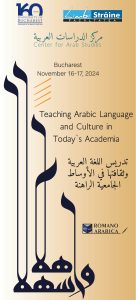
Teaching Arabic Language and Culture in Today`s Academia
16-17 November 2024
International conference with over 30 participants from Arab and Western universities
Organizer: Eduard Bogdan Cojanu
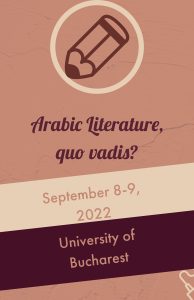
Arabic Literature. Quo Vadis?
8-9 September 2022
International Conference with participants from Qatar, Usa, Georgia, Italy, Israel, Egypt, etc.
The conference`s guest of honor was Tunisian writer Chokri al-Mabkhout, winner of the International Prize for Arabic Fiction (Arab Booker) in 2014 for his novel The Italian
Organizer: Laura Sitaru
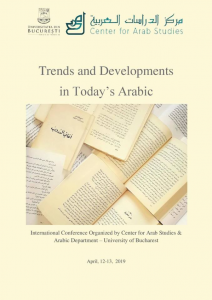
Trends and Developments in Today`s Arabic
12-13 April 2019
International Conference with over 40 participants
Organizer: Ovidiu Pietrăreanu
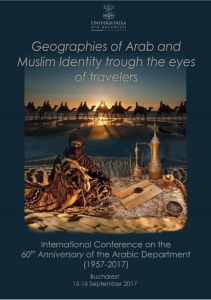
Geographies of Arab and Muslim Identity through the Eyes of Travelers
15-16 September 2017
Celebration of 60 years of Arabic studies in Romania
International Conference with approximately 30 guests from abroad
Launch of the volume „Mărturii din arabistica românească” (Testimonies from Romanian Arabic Studies) authored by Alina Georgiana Focșineanu (interviews with 25 prominent figurs in Romanian Arabic studies)
Organizer: Laura Sitaru
The 11th Conference of AIDA (Association Internationale de Dialectologie Arabe)
25-28 May 2015
Attended by 163 guests from over 40 countries
On this occasion, Romania assumed the presidency of this important international scientific and academic body, through the election of Professor George Grigore, Director of the Center for Arab Studies, to this position
Organizer: George Grigore